

Access control systems are at the heart of modern commercial security. Yet for many UK businesses, security still begins and ends with a simple keycard reader on the door.
In reality, the right access control system does far more than lock and unlock an entrance. It gives businesses visibility over who enters the building, when they enter, and which areas they can access. Integrated properly, access control also strengthens wider security infrastructure, helping organisations manage risk more effectively across their premises.
At W4G Fire & Security, we work with businesses across the UK on everything from straightforward keycard installations to facial recognition, app-based solutions, and fully integrated security platforms. We have seen first-hand what works – and what leaves businesses exposed.
This guide walks you through the main types of access control systems, how they compare, and how to identify the right fit for your premises.
An access control system is a security solution that restricts physical entry to a building or area by verifying a person’s credentials before unlocking a door. Rather than relying on traditional keys, which can be duplicated, lost, or passed on, modern access control systems use digital authentication to give you complete visibility and control over who enters, when, and where.
Done well, they also create a detailed audit trail, integrate with your other security systems, and make it significantly easier to manage access across an entire organisation – not just one door.

The right choice of access control systems depends on a number of factors specific to your business. Here is a breakdown of the main options available to UK businesses:
Keycard systems remain the most common access control method across UK businesses. Employees carry a card or fob, hold it near a reader, and the door unlocks. They are easy to deploy, straightforward to manage, and cost-effective at scale.
The limitation is accountability. A keycard proves a card was used – not that the right person used it. Cards get lost, lent out, or copied. For low-to-medium security environments, this is often an acceptable trade-off. For anything more sensitive, it isn’t.
Best for: Small to medium-sized businesses, offices with moderate security requirements, and any environment where ease of use is a priority.
Biometric access control authenticates the person, not a credential they carry. Fingerprint recognition is the most widely deployed, but facial recognition is increasingly the preferred choice – particularly in post-pandemic environments where touchless access matters.
Biometric systems create a stronger audit trail, remove reliance on physical credentials, and are far harder to circumvent. They do require a higher initial investment and thoughtful implementation. Factors like lighting conditions and privacy considerations need to be addressed during the planning phase.
For UK businesses handling employee biometric data, GDPR compliance and proper consent procedures should always form part of the installation process.
Best for: High-security environments, regulated industries such as healthcare and finance, and any organisation that needs to eliminate the possibility of shared or transferred credentials.
App-based access control solutions use smartphones and Bluetooth technology to replace physical cards entirely. Credentials are stored on the device, access is managed through a cloud platform, and permissions can be granted or revoked instantly – from anywhere.
This approach suits modern workplaces well. Hybrid teams, contractor management, and multi-site organisations all benefit from the flexibility. The trade-off is a dependency on the employee’s phone being charged and present, and the need for a cybersecurity framework to sit alongside the physical access solution.
Best for: Tech-forward businesses, organisations with remote or mobile workforces, and any premises already investing in smart building technology.

For organisations managing multiple access points or needing access control to work seamlessly alongside CCTV, intruder alarms, and barriers, an integrated platform is worth serious consideration. W4G’s Bluetooth control and access control solutions are designed as all-in-one platforms, connecting door access, intruder detection, and building automation in a single system.
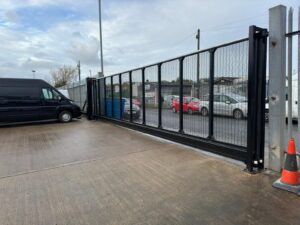
In one recent project, W4G Fire & Security installed a cantilevered automated sliding gate integrated directly with the client’s access control system – enhancing perimeter security and significantly improving site efficiency. You can read more about it in our recent case studies.
As we explored in our blog on CCTV vs Intruder Alarms, layering security systems together produces significantly stronger protection than any standalone solution. The same principle applies here.
Neither is universally “better” – the right choice depends on your risk profile, your industry, and how your building is used day to day. Many businesses operate both, using keycard access for general areas and biometric authentication for server rooms, laboratories, or secure storage.
| Factor | Keycard Access | Biometric Access |
|---|---|---|
| Security level | Medium | Very High |
| Identity verification | Card only | Person verified |
| Audit trail | Good | Excellent |
| Risk of credential sharing | Yes | No |
| Environmental factors | None | Lighting, cleanliness |
| Ease of use | Very High | High |
The right access control system comes down to understanding your own premises, risk level and workforce. These are the key things to consider:
High-value assets, sensitive data, and regulated environments all point toward biometric or integrated solutions. General office access is well-served by keycard or mobile systems.
Cloud-based and app-led systems scale far more efficiently than traditional on-premise setups. If you are managing multiple sites, centralised remote management is essential.
Access control works best as part of a layered system. If you are investing in CCTV or intruder alarms at the same time, an integrated platform delivers significantly better value than three separate installations.
High turnover, contractors, or a hybrid workforce all benefit from the speed and flexibility of mobile or cloud-based access management.
We get asked the same questions every time a business starts thinking about access control. Here are the most common ones.
Biometric systems – particularly iris or facial recognition – offer the highest security because they verify the individual rather than a card or PIN. They are the standard choice for environments handling sensitive data or regulated materials.
Most modern systems operate locally and continue functioning during internet outages. Cloud-based management features, such as remote credential updates, require connectivity – but day-to-day access typically does not.
Yes – and it should. When access control and CCTV are integrated, door events automatically trigger recording in that area, creating visual verification of every entry and exit. W4G designs systems with this integration built in.
This varies by insurer and premises type, but professionally installed access control, particularly when combined with a monitored intruder alarm, is increasingly expected as a baseline for commercial property cover.
With digital access control, credentials are removed instantly through the management platform. There is no need to change locks or retrieve physical keys – a significant operational advantage over traditional security methods.
The technology is only part of the decision. Professional installation, proper configuration, and ongoing maintenance all determine whether your access control system performs as it should. Poorly installed systems, regardless of the hardware, create the exact vulnerabilities they are supposed to prevent.
W4G’s access control installation and maintenance services are backed by SSAIB certification and supported by a team that understands how access control fits into a broader security strategy – not just how to fit a reader to a door frame.
Every building is different. That is why W4G Fire & Security designs access control systems around how your business actually works – not a one-size-fits-all solution.
Whether you need a simple office entry system or a fully integrated multi-site platform, we can help. Contact us for a free consultation.


