

CCTV vs intruder alarms – it is one of the most common questions UK business owners ask when reviewing their commercial security systems. And the most common mistake they make is thinking they have to pick just one.
The difference between CCTV and intruder alarms comes down to how they protect your business:
Neither replaces the other. Together, they form the backbone of a robust commercial security system.
CCTV (Closed-Circuit Television) systems allow you to monitor your property 24/7, in real time or via recorded footage. Modern CCTV installations across UK businesses typically feature high-definition cameras, remote mobile access, and secure on-site or cloud storage.
W4G’s CCTV service includes camera analytics – configurable for loitering detection, line crossing, intrusion zones, and thermal technology to reduce false alarms as well as audio challenge capability, where a monitoring operator can challenge an intruder on-site before escalating to keyholders or police.
CCTV is particularly valuable for:
To understand the real cost of inadequate security, read our blog on 7 of the most expensive stolen items – a reminder of what’s at stake when the right systems aren’t in place.
CCTV does not stop a crime as it happens. If no one is actively monitoring the feed, an incident may only be discovered after the fact, resulting in delayed response times and increased losses. Evidence exists, but the damage is already done.
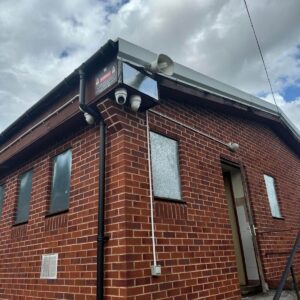
Intruder alarm systems are designed to detect unauthorised access the moment it happens and trigger an immediate response – whether that’s activating a siren, alerting a 24/7 monitoring centre, or notifying a nominated keyholder.
Our intruder alarm systems include wired, wireless, and app-based options, alongside 24/7 monitored systems and dedicated remote support. Both residential and commercial properties are covered.
Alarm systems are critical for:
For a broader look at keeping your premises protected, read our blog about why choose property protection from W4G Fire & Security.
Alarms tell you something has happened. They don’t tell you who, what, or how. Without CCTV working alongside your alarm, police response may be deprioritised and insurance claims become far more difficult to substantiate.
Rather than one being “better” than the other, each system plays a different role in your overall security.
| CCTV | Intruder Alarm | |
|---|---|---|
| Primary function | Monitor & record | Detect & alert |
| Response speed | Passive (requires review) | Immediate |
| Visual evidence | Yes | No |
| Deterrence | High (visible cameras) | Moderate |
| Insurance compliance | Strengthens claims | Often mandatory |
| Out-of-hours protection | Limited alone | Strong |
The British Insurance Brokers’ Association (BIBA), in conjunction with the RISCAuthority, representing UK property insurers, confirms that professionally installed and monitored alarm systems are a standard insurer expectation for commercial premises. CCTV footage strengthens insurance claims significantly when it exists alongside an alarm record.
Understanding the real-world risk makes the case clear.
CCTV only: A business installs cameras, but no alarm. A break-in occurs overnight. The footage clearly shows the intruder, but no one is alerted in real time. The intruder leaves before any response arrives. Evidence exists, but the loss has already happened.
Alarm only: A site installs an alarm without CCTV. The alarm triggers, but there’s no visual confirmation of what occurred. Police response may be slower due to a lack of a verified threat. No evidence is available for the insurance claim.
In both cases, something critical is missing. For businesses in high-risk sectors, including construction sites where plant and equipment theft is a persistent threat, a single-system approach is a genuine liability. Read our blog on construction security for more on protecting high-risk sites.
The shift across the UK security industry is clear: the CCTV vs intruder alarms debate is being replaced by integrated security thinking.
At W4G Fire & Security, the majority of our commercial installations now combine both systems into a single, connected solution. When an alarm triggers, it automatically activates the relevant CCTV cameras. Our monitoring team can view live footage the moment an alert fires, enabling faster and more accurately targeted responses. False alarms are reduced through real-time visual verification.
Combined with access control systems – managing who can enter your premises and when, you gain a complete picture of every security event, before, during, and after.
Where a physical response is required, our mobile patrols, keyholding and response service ensures that when an alarm activates, a trained officer can attend your site – not just a remote alert.
For the vast majority of UK businesses, the answer is yes. You almost certainly need both if:
If you also employ security guards on-site, integrating CCTV with your guarding operation creates a layered defence that no single measure can replicate.
Costs depend on the size and complexity of your premises. Many businesses offset these costs through reduced theft and damage, lower insurance premiums, and stronger claims outcomes. W4G Fire & Security’s nationwide service and maintenance packages ensure your investment stays compliant and functional long after installation.

CCTV vs intruder alarms is ultimately a decision that should be guided by a professional risk assessment tailored to your premises. The right combination depends on:
We provide a free, no-obligation security assessment that evaluates your premises and risk profile before recommending a solution.
For most small businesses, CCTV vs intruder alarms should not be an either/or decision. A basic integrated package combining a monitored alarm with a small HD CCTV system is typically affordable and covers both detection and evidence. We design cost-effective solutions for businesses of all sizes across the UK.
Many UK commercial insurers require a professionally installed and maintained intruder alarm as a minimum condition of cover, particularly for premises holding high-value stock. Requirements vary by insurer and risk level – always check your policy schedule and consult your insurer directly.
An integrated security system connects your CCTV, intruder alarm, and access control so they work together – sharing data, triggering cross-system responses, and feeding into a single monitoring platform. This is now the recommended standard for commercial premises in the UK.
Alarm systems should be inspected and maintained at least twice a year by a qualified engineer. CCTV systems should be reviewed annually as a minimum.
If you are unsure whether your current setup is adequate, or you are starting from scratch, a professional assessment is the smartest first step.
W4G Fire & Security helps businesses across the UK design security systems matched to their specific risks, operations, and budgets. W4G Fire & Security is SSAIB-certified and holds ISO 9001 accreditation for Quality Management – so you can trust both the advice and the installation.
Get in touch for a free, no-obligation consultation. Contact us at 020 800 43800 or email hello@w4g-security.com today for more information.
Contact Us


