

Throughout history, some of the world’s most valuable possessions have been stolen despite seemingly robust security measures. From priceless artworks to crown jewels, these high-profile thefts highlight the importance of investing in the right security services to protect valuable assets.
With the right type and degree of security services in place, these things shouldn’t happen, especially when possessions have significant value. In this article, we look at five of the most expensive items that have been stolen to date, as well as if and how they were recovered.
We were inspired to update this article following a string of high-profile thefts that have made headlines in recent years, proving that even the most valuable possessions remain at risk without the right security in place.
In December 2024, a lone intruder broke into a luxury home in London’s Primrose Hill, climbing through a second-floor window while the residents were away. The thief made off with over £10.4 million worth of bespoke jewellery, £150,000 in Hermès handbags, and £15,000 in cash. Despite the property being located in one of the capital’s most affluent areas, the burglar was able to exploit unguarded entry points and gain access in broad daylight. A reward of up to £1.5 million has been offered, but at the time of writing, the suspect has not been caught, and the jewellery remains unrecovered. [Source: BBC.com]
Cases like these highlight just how important it is to have the right combination of property security, CCTV surveillance, and intruder alarm systems – not just in commercial settings, but for private residences too. While the items on our list below may be worth far more, the lesson is always the same: robust, layered security is the best line of defence. Let’s get into the list of five items:
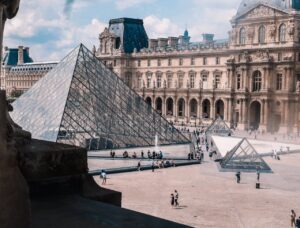
In what has become one of the most talked-about museum thefts in modern history, four thieves disguised as construction workers broke into the Louvre’s Apollo Gallery on 19 October 2025. Using a truck-mounted furniture lift, they accessed a second-floor balcony, smashed through a window with angle grinders, and made off with eight pieces from the French crown jewels collection in under eight minutes. The stolen items included a sapphire tiara, emerald jewellery belonging to Empress Marie-Louise, and a pearl-and-diamond tiara once worn by Empress Eugénie. [Source: NBC News]
During their escape, the thieves dropped Empress Eugénie’s crown on the pavement, crushing it in the process. Remarkably, almost all of its 1,354 diamonds and 65 emeralds survived, and the Louvre has since begun a restoration effort estimated at around $47,000. As of February 2026, multiple suspects have been arrested – including all four members of the gang but the remaining jewels have not been recovered and are listed on Interpol’s Stolen Works of Art database.
In the aftermath, the Louvre’s director acknowledged that the museum had “very inadequate” and “outdated” security systems. Audits carried out over the previous decade had flagged issues with CCTV coverage and insufficient monitoring screens in the control room. This incident is a powerful reminder that even world-famous institutions can fall short when security systems are not regularly reviewed and maintained. At W4G Fire & Security, we offer ongoing service and maintenance to ensure your security infrastructure remains effective and up to date.
Dorothy’s iconic ruby slippers from the classic film The Wizard of Oz were stolen from the Judy Garland Museum in Minnesota in 2005, when a thief used a hammer to smash through a glass display case during the night. For 13 years, the slippers remained missing until the FBI recovered them in a 2018 sting operation.
The original theft itself was low-tech: a hammer through a display case, with no adequate intruder alarm or overnight security guard presence to prevent it.
It’s a sobering reminder that even basic security measures – such as a monitored alarm system and regular keyholding and response could have prevented the theft entirely.
[Sources: NPR]

Dubbed the “heist of the century”, a team of criminals led by Leonardo Notarbartolo broke into the vault of the Antwerp Diamond Centre in Belgium over a weekend in February 2003. They made off with loose diamonds, gold, silver, and jewellery collectively worth over $100 million – some estimates put the figure as high as $500 million.
What made this theft extraordinary was the vault’s seemingly impenetrable security: combination locks, infrared heat detectors, seismic sensors, Doppler radar, and a magnetic field alarm. Yet the thieves bypassed every layer, reportedly using hairspray on heat sensors, a custom aluminium plate to maintain the magnetic field, and a bespoke three-dimensional key. Notarbartolo was sentenced to 10 years in prison and released on parole in 2009, but was rearrested in 2013 for violating his parole conditions and served the remainder of his sentence until 2017. Most of the diamonds have never been recovered.
Update – August 2025: The story was brought back into the spotlight with the release of Stolen: Heist of the Century on Netflix, a documentary featuring interviews with both the lead detective and Notarbartolo himself – speaking on camera for the first time about his role in the theft.
The Antwerp heist is a textbook example of why layered security must be continuously tested and upgraded. [Sources: Wikipedia, Netflix – Stolen: Heist of the Century]
The first thing to note with ‘The Scream’ is that Edvard Munch created four versions of this iconic painting. The most valuable of which, believed to be valued at in excess of £92m, was stolen in 1994 from the National Gallery in Oslo. The thieves entered through a ground-floor window and were in and out within minutes. They even left a note reading “Thanks for the poor security.” The painting was recovered undamaged just three months later after their ransom demands were not met.
A second version of the painting was stolen in 2004, this time from the Munch Museum, also in Oslo, when armed robbers tore it from the wall in front of shocked visitors. That version was recovered in 2006 with some minor damage.
Both thefts exposed weaknesses in museum security that are still being learned from today. Effective intruder alarm systems and 24/7 CCTV monitoring are essential for protecting high-value assets – whether in a gallery, a warehouse, or a commercial premises.

Renowned as one of the most brazen and lucrative heists in American history, this heist was carried out by a group of journalists at the New York Daily News. The group saw a loophole in the law and decided to expose it to prove that the transfer of the deeds, valued at £1.46 billion, was possible. These journalists were able to convince the city of New York to transfer the deeds to the Empire State Building to a fraudulent party, which was achieved by making use of a false notary stamp. Once the loophole was exposed, New York Daily News transferred the deeds back to the city.
While not a traditional theft, this case shows that security vulnerabilities aren’t always physical – weak administrative processes and poor identity verification can be just as dangerous. Businesses today can protect against similar risks through robust access control and automatic number plate recognition (ANPR) systems that ensure only verified individuals gain entry.
[Sources: NPR]

A total of 50 Fabergé Eggs were produced by The House of Fabergé and they were created for the Russian royal family. These impressive items were produced from 1885 to 1917, the eve of the Russian Revolution. However, eight of the eggs were taken by the Bolshevik revolutionaries and, from that point, were not seen again by the Russian Royal Family. To date, only one of the eight missing eggs has been retrieved. In 2012, a Fabergé Egg was discovered at a scrap metal dealership in the American Midwest – the buyer had purchased it for around $14,000, completely unaware of its true value. The precious egg went on to sell for over £25m. As of 2026, seven of the original eight eggs remain missing.
With seven Fabergé Eggs still unaccounted for over a century later, this is a stark reminder of what can happen when valuable items are not properly catalogued, tracked, and protected.
Modern property protection strategies – including asset tracking, secure storage, and comprehensive CCTV systems can help ensure that valuable items are always accounted for.
[Sources: CNN, PBS News]

There’s no prize in guessing the item that makes the top of our list! The famous Mona Lisa painting, believed to be worth in excess of £2 billion, yet is unlikely to ever be sold to an individual, was stolen in 1911. The painting was stolen by a man named Vincenzo Perugia, a handyman who was working at the Louvre at the time.
The Mona Lisa remained missing for over two years before Perugia was caught attempting to sell it to an art dealer in Florence in 1913. Today, with an estimated insurance value exceeding £2 billion, it serves as a powerful example of how insider access can bypass even well-guarded environments – a vulnerability that modern access control systems are designed to prevent.
[Sources: History.com, Smithsonian Magazine]
Each of these high-profile thefts reveals common security failures that remain relevant today, whether you’re protecting commercial premises, valuable assets, or private property. The key lessons include:
Don’t wait for a security breach to review your protection measures. Whether you need property protection, commercial CCTV systems, vacant property security, or a comprehensive security audit, our experienced team is here to help.
We serve businesses and individuals across the UK, including Exeter, Devon, Liverpool, London, Birmingham, Bristol, Cardiff, and Manchester. Contact us today to discuss how we can safeguard what matters most to you.


